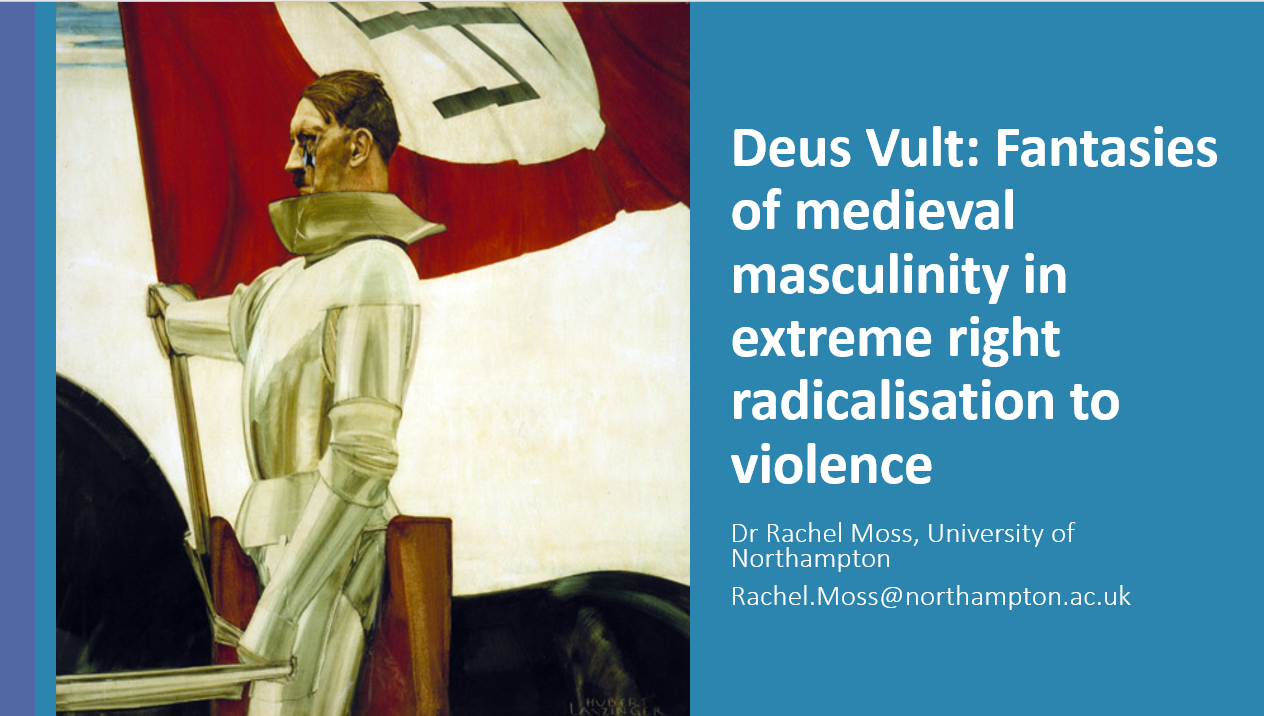
This weekend I was fortunate enough to be funded by my institution to attend and present a paper at COMFAS 23 – the International Association for Comparative Fascism Studies‘ annual conference. This sixth meeting of the conference was based around the theme of Radicalization to Violence: Paramilitarism in Fascism and the Radical Right, and it was an excellent opportunity for me to introduce my new research into medievalism, masculinity and the emotionology of the extreme right, with particular attention on accelerationism.
There are lots of academic buzzwords there! What that means for my general audience is that I’m now (alongside my other medieval studies work!) researching how the medieval intersects with the modern extreme right, particularly those people who are invested in accelerating through terrorist violence what they perceive to be the inevitable downfall of society. Cheerful stuff!
While medieval studies as a whole has shown a troubling inertia about the ongoing weaponization of medieval history by extremists, a number of scholars are doing groundbreaking work in this area. These scholars have overwhelmingly been marginalised within the academy on one or more axis. Many are precariously employed and many are people of colour. It is very easy for white scholars (like me!) to package an awareness of the failings of the field of medieval studies as something new and unexplored – “an obliviousness that comes with the privilege of a white lens” as Mary Rambaran-Olm writes. In fact this work has been going on for years, although the specific academic focus on the draw of the Middle Ages for white supremacists has sharpened since extremist Anders Breivik murdered seventy-seven people in Norway, declaring himself a modern Knight Templar. Andrew Elliott’s monograph on medievalism and mass media, published in 2017, made the very important case for the “banal medievalisms” of popular culture that, disconnected from any deep understanding of medieval history, serve to underpin dangerous political ideologies in ways that cannot be mitigated by mere “myth-busting”.
This is where a lot of the work done by medievalists on the extreme right on the co-option of the medieval past falls down, because it has been preoccupied with the historical inaccuracies in the fascist medieval imaginary, rather than really grappling with the issue of how, to use Elliott’s term, these banal medievalisms are weaponised in the construction of a shared political worldview underpinned by a complex emotionology (in simple terms, the “attitudes or standards that a society, or a definable group within a society, maintains toward basic emotions and their appropriate expression”, Kleinginna and Kleinginna, 1981). That is at the heart of what I hope will be a much larger project with my colleagues at Northampton; while there are a number of medievalists doing interesting work in this area, as far as I know there aren’t any who are developing research strands of direct collaboration with experts in historic and contemporary fascism and so I am very excited about the work ahead of us! We have some funding applications in the works so keep your fingers crossed.


This is brilliant and I’m really happy to see it. I’m guilty of going after the inaccuracies myself, partly because I think breaking the fantasy helps destabilize it’s power, but you’re right that this is much more useful and necessary when it comes to tackling the fascism issue.