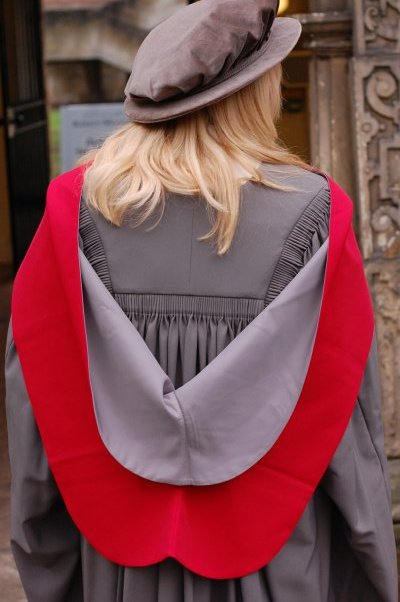
I have been Dr Moss for sixteen years today, when on a cold January day I walked across the stage at Central Hall at the University of York. It has been an eventful sixteen years, to say the least. That January, and for a long time afterward, I would think of the PhD as the greatest accomplishment of my life. It’s still up there, don’t get me wrong, but there are some other things in the mix there, including parenthood and surviving traumatic bereavement.
My career trajectory is not so very different from the average person in the UK who “makes it” in academia, which these days looks a bit like this: living in six cities in two different countries, working at five academic institutions in eight academic jobs. Mix in a couple of office admin jobs too, just for fun. Have two postdoctoral fellowships, one finally “open ended” (I won’t say permanent any more!) job that results in two promotions (Lecturer – Senior Lecturer – Associate Professor) but also stir in two redundancy consultations at that same institution. Hustle, because you know you need to make more money because that open ended job is neither full time nor guaranteed to be permanent, so add some freelancing to all of that.
I’m not complaining. Despite all the challenges facing us in UK HE, I do by and large love what I do. But it’s not a straightforward or easy journey, and despite the increasing difficulty of finding stability in terms of role, location, salary, more and more is expected of us from employers and funders. I am always very conscious that I have not published as much as I “should”. Let’s put that in bald terms: one monograph, one edited collection, five chapters, four articles. I have an edited collection and two articles under review at the moment. For sixteen years it doesn’t feel like a lot; certainly I know job panels and funding boards have thought so.
But in those sixteen years of living in different places, learning the quirks of different institutions as well as in the ins and outs of my job, creating new modules and marking more essays than I can count, I also got married. I had a very happy marriage for a long time, until my husband’s illness killed him, but not before it broke him, and nearly broke me as well. I grew in my body a whole human being and have raised her for nearly five of her ten years as a single widowed parent, cradling her grief as well as my own. I have survived a blood clot in my lung and sepsis in my gut. I have learned to paint and I have started singing with a choir again after many years of not. I have maintained deep friendships and made new ones. I have made a lot of mistakes, sometimes hurting other people and sometimes only hurting myself. I have found that as deep as my capacity is for grief, my capacity for joy runs even deeper.
I have been a doctor for thirty-seven per cent of my life. Some of these experiences I have been able to capture in brief lines in funding and job applications – I took maternity leave in 2015; I was widowed in 2021. But they are always framed as reasons to explain why I am not where I could be, where I “should” be. What would it mean if our CVs captured something of the deep complexities of our lives, our pains and joys, the burdens we have carried alongside our work? What kind of academia could we build if we started with the assumption that nearly all of us are doing our best, and that what we need is not competition but collaboration? What kind of higher education culture would give us room to rest? And what kind of academy would it be if our griefs and joys were recognised as making us into the academics we are today – not things to be explained away or neatly labelled to justify our failings, but celebrated in all their complications as part of what makes us human beings who can do the work? In an age of AI, where increasingly machines are swallowing up people’s jobs along with people’s capacity to critically think, it seems important to me to recognise that what makes academics special is that we are not automatons. We are human. Sometimes we fail. But sometimes we fly.
 Rachel E. Moss
You are exceptional in every way, but especially in how you have nurtured your daughter and continue to help her grow into the most fascinating, wise, delightful woman. What an achievement x ________________________________
Love this. Radiant being. Why can’t we put that in CV’s?